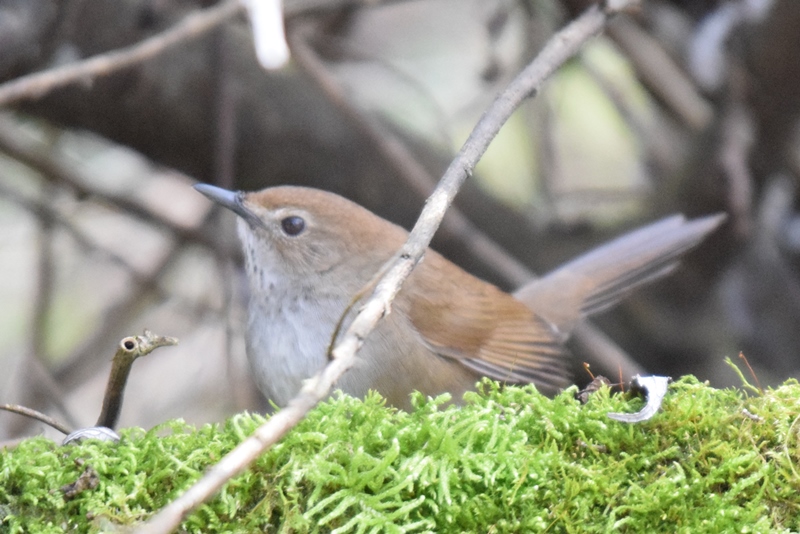
Vietnam 11-18Jan10
From JS
Our Vietnam trip didn't really take placed as
planned. I planned to see the pittas but didn't, even though the first bird I
saw everyday was the bar-bellied pitta stuck on a poster. I planned to go
sight-seeing but ended up birdwatching. I planned to walked at most 10km but
ended up walking about 100km! I planned to stay on the road, instead I found
myself climbing up a hill slope, not once but twice! I planned to enjoy air-con
room-like temperature but suffered chilly conditions.
Anyway, we somehow still got more than what we asked for. An orange-necked
partridge in the first day and, remarkably, the bird was seen nowhere near the
bamboos, where we were expecting to find them but wouldn't have the chance to do
so in this trip. We planned to see 4 endemics but got 6 instead, including one
new split! (The black crowned fulvetta was splitted from the rufous-winged
fulvetta.)
List of Birds seen at Southern Vietnam:
1)
Orange-Necked Partridge (1)
2)
Scaly-Breasted Partridge (>4)
3) Red Junglefowl (>3)
4)
Siamese Fireback (>2)
5)
Germain's Peacock Pheasant (1)
6)
Green Peafowl (1)
7)
White-Browed Piculet (2)
8) White-Bellied Woodpecker (>1)
9) Greater Yellownape (1)
10)
Grey-Headed Woodpecker (1 juvenile male with bars on the belly was seen)
11) Greater Flameback (>1)
12)
Black-and-Buff Woodpecker (1)
13)
Red-Vented Barbet (1 seen, >4 heard)
14) Lineated Barbet (>3)
15)
Green-Eared Barbet (2)
16) Blue-Eared Barbet (3, >2 heard)
17) Coppersmith Barbet (>2)
18) Oriental Pied Hornbill (h)
19) Great Hornbill (>3)
20) Orange-Breasted Trogon (1)
21)
Indian Roller (>5)
22) Dollarbird (>4)
23) Common Kingfisher (2)
24) Banded Kingfisher (h)
25) Stork-Billed Kingfisher (1)
26)
Chestnut-Headed Bee-Eater (3)
27) Banded Bay Cuckoo (h)
28) Violet Cuckoo (2)
29) Green-Billed Malkoha (>3)
30) Greater Coucal (1 seen, >2 heard)
31) Lesser Coucal (>2)
32)
Vernal Hanging Parrot (2)
33) Red-Breasted Parakeet (>20)
34) Swiftlet spp.
35) Asian Palm Swift (3)
36) Collared Scop Owl (1 h)
37) Asian Barred Owlet (2 h)
38) Brown Hawk Owl (>2 h)
39)
Great-Eared Nightjar (2, >2 heard)
40) Spotted Dove (Abundant)
41) Red-Collared Dove (>10)
42)
Pompadour Green Pigeon (>7)
43) Thick-Billed Green Pigeon (>5)
44)
Green Imperial Pigeon (3)
45) Black-Backed Swamphen, viridis (>5)
46)
Bronze-Winged Jacana (8, including 1 juvenile)
47) Red-Wattled Lapwing (2)
48) Osprey (2)
49) Black Baza (2)
50) Black-Shouldered Kite (2)
51) Sparrowhawk sp. (1) Danny: likely an accipiter with pale underparts and it flew with a peculiar figure of 8 flapping motion. JS: According to my father, this should be a Japanese sparrowhawk. However, I am not certain if that is the right id because 4 sparrowhawks (chinese, jap, besra and shikra) can be found in Cat Tien.
52) Little Egret
53) Great Egret (2)
54) Purple Heron (>3)
55) Chinese Pond Heron
56) Yellow Bittern (2)
57) Cinnamon Bittern (1)
58)
Woolly-Necked Stork (1)
59) Lesser Adjutant (2)
60) Blue-Rumped Pitta (1 h)
61) Bar-Bellied Pitta (2 h)
62) Dusky Broadbill (4)
63) Black-and-Red Broadbill (>1 seen by my father)
64) Banded Broadbill (2)
65) Blue-winged Leafbird (2 seen at Cat Tien and 1 orange-naped individual seen at aprrox. 1500m at Ta Nung Valley, Dalat, maximum known altitudinal limit.)
66) Brown Shrike
67)
Ashy Woodswallow (>30)
68) Black-Naped Oriole (1)
69)
Hooded Oriole (1)
70) Scarlet Minivet (>5)
71) Bar-Winged Flycatcher-Shrike (>8)
72) Black Drongo (>15)
73)
Ashy Drongo (1 grey variant with white eye patch, >10 black variant with slaty underparts and red eyes)
74)
Spangled Drongo (1)
75) Bronzed Drongo (1)
76) Greater Racket-Tailed Drongo (>2)
77) Black-Naped Monarch (2)
78) Asian Paradise-Flycatcher (1)
79) Common Iora (Seen by Tuyen and my father)
80) Great Iora (>4, initiator of 2 birdwaves)
81) Large Woodshrike (2)
82) Asian Brown Flycatcher (1 seen by Tuyen)
83)
Red-Throated Flycatcher (>3, Always calling a distinct metallic "cher" call)
84) Verditer Flycatcher (>10, Always seen exposed on electrical cables and bare branches in open areas)
85)
Hainan Blue Flycatcher (1 1st winter male and >3 females were seen)
86)
Blue-Throated Flycatcher (1 male seen)
87) Siberian Blue Robin (1 male, 1 first winter male and 1 female were seen. 1st winter male was seen at Ta Nung Valley, est 1500m, possibly a new record for Dalat.)
88) Oriental Magpie Robin (1 seen by Tuyen)
89) White-Rumped Shama (>4)
90) Forktail? (2 black-backed birds were seen at Cat Tien. Possibly White-Crowned or Black-Backed Forktails, though none is recorded in Cat Tien. Id will be kept at forktail because long barred, forked tail were seen.)
91)
Pied Bushchat (1 male in breeding plumage was seen)
92)
Vinous-Breasted Starling (>3)
93) Hill Myna (2 - hoped to turn it into a gold-crested myna but seeing that the yellow on the head is limited to the hindneck, there's no real debate on its id...)
94) Velvet-Fronted Nuthatch (4 - These sightings provided great comparison with its yellow-billed cousins that were seen 3-4 days later.)
95) Barn Swallow
96) Pacific Swallow (>1, Confirmed sighting is limited to the crocodile lake.)
97) Red-Rumped Swallow (>5 - Birds seen had white rumps like some in Singapore. This feature is regularly seen but not well-documented/understood. The pink rumped and white rumped birds may be different variants or moults (breeding or non-breeding plumage?))
98)
Northern House Martin (2 confirmed sighting. Debatable sightings made throughout trip due to bad lighting that made the uppertail and underwing coverts difficult to observe. Additionally, this species and the Asian House Martin looked similar to the untrained eyes like mine, esp when head is tilted. However, over time, seeing that only the martins fan their tails in flight made it easier to separate the families apart at one look.)
99) Asian House Martin (>5)
100) Black Crested Bulbul (>30, abundant at 1500m)
101) Sooty-Headed Bulbul, klossi (>10, similar numbers at Cat Tien and Dalat)
102) Striped-Throated Bulbul (4)
103)
Streak-Eared Bulbul (>2)
104) Ochraceous Bulbul (>6)
105) Yellow-Bellied Prinia (h)
106)
Plain Prinia (3)
107) Common Tailorbird (h)
108) Dark-Necked Tailorbird (>1)
109)
Buff-Throated Warbler (>2)
110)
Radde's Warbler (3)
111) Pallas's Leaf Warbler (h - according to birdlifeindochina's checklist, this species is possible at Cat Tien, albeit out of altitudinal
range.)
112) Yellow-Browed Warbler (>10 identified by call, "swe-it")
113) Arctic Warbler (>2 identified by call, "dydydydydydydy".)
114)
Pale-Legged Warbler (4 identified by call, "tzip")
115) White-Crested Laughingthrush (h)
116)
Puff-Throated Babbler (3 - very approachable)
117) Scaly-Crowned Babbler (3)
118) Large Scimitar Babbler (h at the grassland - but, calling from the woodlands.)
119) Striped Tit Babbler (>5)
120)
Grey-Faced Tit Babbler (3, easy to misid from the above cousin. Distinguished by the few faint non-black breast streaks,
orangey-rufous crown and grey face, including supercilium)
121) Chestnut-Capped Babbler (h)
122) Scarlet-Backed Flowerpecker (>2)
123) Brown-Throated Sunbird (1)
124) Ruby-Cheeked Sunbird (1)
125) Olive-Backed Sunbird (Seen by Tuyen)
126) Little Spiderhunter (Seen by Tuyen)
127) Grey Wagtail (>5, most seen near rivers, both high- and lowlands.)
128) Glossy Ibis (1 seen flying away with dark, white-streaked head and pale curled bill. Wished that it could be a White-Shouldered or Giant Ibis instead!)
129) Bar-Backed Partridge (h)
130)
Golden-Throated Barbet, auricularis (>10, Common at elevations >1600m)
131)
Annam Barbet (>10, Common at elevation est. 1500m - Seen feeding on
lantana fruits in open shrublands, not broadleaved forests! Looks similar to
black-browed barbet, except for red hindcrown. This species is considered a new
split from the black-browed barbet.)
132)
Blue-Bearded Bee-Eater (1 seen on the last day at the 2nd last hour!)
133) Collared Owlet (1h - Luyen uses this bird's call to stir up a birdwave. Successful for attracting the yellow-billed nuthatch, minivets, fulvettas and tits, which in turn attracted larger birds like the cutias, crossbills and sibias.)
134)
Barred Cuckoo Dove (4)
135) Mountain Imperial Pigeon (>10)
136)
Grey-Faced Buzzard (1, misid by all of us as a crested goshawk.)
137) Black Eagle (2)
138) Changeable Hawk Eagle (2)
139) Accipter? Danny: a hawk eagle with brown upperparts ruling out Black Eagle. Over at Dalat sunset around 5.30/5.45 pm (short daylight during winter months) and the Hawk was sighted after 6 pm. JS: a raptor seen in a pine forest at Ho Tuyen Lam. The bird flew pass us at middle-storey level. It has a brown plumage, barred uppertail and patterned underparts. I am not sure if it is an accipter or other small hawks but it may be the same species as the sparrowhawk seen at Cat Tien.
140)
Burmese Shrike, nigricapillus (4)
141)
Eurasian Jay (1, >2 h)
142)
Indochinese Green Magpie (1 seen flying across the road, 1h. Distinguished by brown wings and yellow underparts. Not sure why it is called a green magpie when green is not obvious.)
143)
Slender-Billed Oriole (2, pine forest specialist)
144)
Maroon Oriole (4, montane broadleaved forest specialist)
145) White-Throated Fantail (>6)
146) Lesser Racket-Tailed Drongo (1 seen mimicking other birds' calls and stealing a scarlet minivet's caterpillar.)
147) Grey-Chinned Minivet (>4, Luyen overlooked this species as the scarlet minivet but the smaller size and grey
chin differentiate it.)
148)
Long-Tailed Minivet (>6, pine forest specialist)
149) Blue Rock Thrush (2)
150)
Blue Whistling Thrush, eugenei (2, 1 bird stood beside the road, leading us to find a pair of redstarts.)
151) Siberian Thrush (1 female seen feeding on fruits with the golden-throated barbets)
152) Lesser Shortwing, langbianensis (1 male seen in the shrubs!)
153)
Rufous-Gorgeted Flycatcher (2 males were seen with 1 giving very good, close view in the montane broadleaved forest "trail". A
lifer for Luyen and a rare sighting for this underobserved species in Dalat!)
154) Little Pied Flycatcher (>3)
155) Grey-Headed Canary Flycatcher (>8, always seen holding a territory near water bodies.)
156) Slaty-Backed Forktail (>2)
157)
Spotted Forktail (3)
158)
Grey Bushchat (2 males and 3 females.)
159) Eastern Stonechat (1 male.)
160)
Black-Collared Starling (>2)
161)
Chestnut-Vented Nuthatch (>2)
162)
Yellow-Billed Nuthatch, (2 seen in a birdwave but could be more if the birdwaves seen are not the same flock of birds
appearing many times.)
163)
Brown-Throated Treecreeper (1 seen. Interestingly, the bird had faint black bars on the lighter brown tail (contrasting with the brown wing) and 2 faint buffish bars on the wing-coverts. Didn't have good views of its belly but the bird looks like a bar-tailed,
brown-throated tree creeper... Unfortunately, I had no photos.)
164)
Green-Backed Tit, legendrei (>10, Pine Forest Specialist)
165)
Yellow-Cheeked Tit, subviridis (>5)
166)
Grey-Crowned Tit, annamensis (4, splited from black-throated tit)
167) Red-Whiskered Bulbul (>5)
168)
Flavescent Bulbul (>5)
169) Ashy Bulbul, hildebrandi (>2)
170) Mountain Bulbul (>4)
171)
Black Bulbul (>50)
172)
Hill Prinia (2)
173) Grey-Bellied Tesia (3 h)
174) Mountain Tailorbird (>3)
175) Eastern Crowned Warbler (2, identified by lack of white-edged tertials, single wingbar, yellow vent and contrasting central crown stripe.)
176) Blyth's Leaf Warbler (suspected)
177) White-Tailed Leaf Warbler, klossi (2 suspected individuals. Luyen says it is distinguishable by the bright yellow belly but I am not convinced in any way because extent of yellow for warblers are variable for individuals. Assuming he is right, another tick for me!)
178)
White-Spectacled Warbler (2 individuals were identified at >1600m, based on green-yellow lore and greenish appearance.)
179)
Grey-Cheeked Warbler (>3 individuals were identified at <1600m, based on grey lore)
180) Chestnut-Crowned Warbler (1)
181)
Chinese Leaf Warbler (1 seen in close, good view at rapids, showing me its yellow basal-part of rump and white distal-part of rump,
2 buffish wingbar, black, white-fringed tertials, greyish-green mantle, pale yellow supercilium & crown stripe (contrasting against greyish-green), black eyestripe and yellowish underparts. I think it is a chinese leaf warbler.)
182)
White-Cheeked Laughingthrush (>20)
183)
Orange-Breasted Laughingthrush (1 seen moving in undergrowth and another heard)
184)
Collared Laughingthrush (Good views of 1 and >7 heard. It looks like a black-hooded, orangey, chestnut-crowned/silver-eared
laughingthrush.)
185) White-Browed Scimitar Babbler (2h)
186) Red-Billed Scimitar Babbler (>2 h)
187) Silver-Eared Mesia (Seen by Luyen)
188)
Vietnamese Cutia (2 seen at a pine forest and >6 seen at a broadleave forest, feeding on figs.)
189) White-Browed Shrike-Babbler, annamensis (1 female seen)
190) Blue-Winged Minla, orientalis (>10)
191)
Black-Browed Fulvetta (1)
192)
Indochinese Fulvetta (1 seen in a flock of fulvettas. It had brown streaks at the throat, brownish and smaller appearance)
193) Mountain Fulvetta (>20)
194)
Black-Headed Sibia, robinsoni (>5)
195)
Rufous-Backed Sibia, eximia (>2)
196) Pygmy Wren Babbler (3h)
197)
Grey-Crowned Crocia (>7 seen, including a flock of 5-6 birds)
198)
Fire-Breasted Flowerpecker (>2)
199)
Mrs Gould's Sunbird, annamensis (>30 seen at all elevations in Dalat)
200) Black-Throated Sunbird, johnsi (>5, seen only at Ta Nung Valley)
201) Streaked Spiderhunter (>4)
202) White-Rumped Munia (>6)
203)
Vietnamese Greenfinch (>4)
204)
Red Crossbill (2, including 1 pinkish male and yellowish female)
205) Large-Billed Crow (>3)
206)
Plumbeous Redstart (2, including 1 male and 1 female)
207) Asian Fairy Bluebird (3)
208) Scaly-Breasted Munia
209) Chestnut-Winged Cuckoo (1 seen at approx. 1500m)
I bet that all of you have seen this species (Blue-winged Leafbird) and in
large number. Even with the eyes closed, you won't be able to forget how it
looks like. The blue wing, yellow hood and blue malar stripe, all part of its
bright green body.
Even so, I have no better bird species to represent this country, Vietnam.
Vietnam borders Laos, Cambodia and China. Yet, its forest, both high- and
lowland's, is rich with birdlife found nowhere else on Earth. Almost every
species of birds we find in the peninsular that are shared with Vietnam have an
endemic subspecies found only in Vietnam. The blue-winged minla found at Dalat,
has grey wings instead of blue. The rufous-winged fulvetta has black crowned
and, only recently, it was considered a new species, black-crowned fulvetta.
To illustrate this further, I have chosen to show my photos of the
blue-winged leafbird, which I saw at Ta Nung Vally, Dalat, at approx. 1500m, its
maximum altitudinal limit according to Craig Robson's. I am not sure which
subspecies it belongs to, if any. Looking at my photo, the bird has a green
ear-covert which disjoin the yellow bib around its black face patch. Its
hindcrown/hindneck is orangey-green. The malar stripe looks greyish, rather than
bluish, suggesting that the bird is still in the moulting process into its
breeding plumage. (Sounds weird but my guide, Luyen, told me that the Dalat's
black-headed sibia has a seasonal grey collar, so a blue-winged leafbird having
such a feature is nothing new in Vietnam.) Craig Robson's suggests
moluccensis but its range doesn't include S.Annam.
Cochinchinensis
is the most likely subspecies but Craig Robson didn't describe it. Checking OBI,
I found a photo of the
cochinchinensis
male. Honestly, comparing the photos, the bird doesn't look like a
cochinchinensis.
Kok Hui commented that:
There are some discrepancies in the naming of BW Leafbird subspecies in the
literature. According to the IBC website, there are 7 subspecies and the one in
S Indochina is
auropetus.
cochinchinensis is supposed to be
confined to Java, but not sure why Robson listed it as the subspecies in S
Indochina. This might explain why your bird doesn't look like
cochinchinensis, because it isn't!
- chlorocephala (Walden, 1871) - extreme E Bangladesh and NE India (Assam) E to Myanmar and W Thailand.
- kinneari B. P. Hall & Deignan, 1956 - S China (S Yunnan), N Indochina and NE Thailand.
- auropectus Wells et al., 2003 - SE Thailand and S Indochina.
- serithai Deignan, 1946 - N Malay Peninsula.
- moluccensis (J. E. Gray, 1831) - S Malay Peninsula, Sumatra and satellites and N Natuna Is.
- viridinucha (Sharpe, 1877) - Borneo (except far N).
- cochinchinensis (J. F. Gmelin, 1789) - Java.
Vietnamese Greenfinch
Grey-Crowned Crocia
Collared Laughingthrush (if you can see it.) [Better to see this
link]
Female
Vietnamese Cutia. A lot of attempts were made to see this bird,
let alone photograph it. Thankfully, my photo was adequately taken to both id
the bird and capture some of its beauty (its colour is much nicer and richer in
real-life.)
Here's some photos of the
Plumbeous Redstart, which is new to Luyen,
my guide. His knowledge of the birds is too centered on the forest, so much so
that much of the montane streams/rivers are under-explored or even visited.
Although he visited this rapids, which this couple is wintering/breeding in, a
few times before, the effort to find the redstarts and co. is minimal.
Basically, only by chance can this family of birds be found. Too few birders for
too many sites.
Here's the photos of the family of birds that have unique subspecies found
only in Dalat. Unfortunately, I don't have photos of the endemic grey-crowned
tit (recent split from black-throated tit) and my
Yellow-cheeked Tit
photo is, honestly, an insult to the actual bird itself - sharing it for record
sake.
FYI, the great tit-like bird in the photos is the
Green-backed Tit.
Unlike the yellow-cheeked tits, which are found in the broad-leaved forest, the
green-backed tits in Dalat are pine forest specialists.
Attached are records shots of the golden throated barbet
auricularis, annam
barbet and green-eared barbet. The
Golden-throated Barbets were seen in flocks of >10 at attitudes
>1600 m. Below that, we saw only the lantana-eating
Annam Barbet.
Unfortunately, I don't have photos that shows the Annam Barbets distinctly.
Although there is only subtle visible difference, I am not very sure why it was
considered a distinct species, Annam Barbet, instead of Black-Browed Barbet.
Still, I have attached a record shot of it. Let me know if you can see any
visible difference between it and the peninsular Black-Browed Barbet.
While golden-throated and annam barbets are highland barbets, the
Green-eared Barbets are lowland specialists. Very similar to the lineated
barbet, which we also saw at Cat Tien, the green-eared barbet is harder to find
and we only managed to have a very distant view of this barbet on the last day.
Still, a valid lifer for me!
Kok Hui commented that the Black-browed Barbet complex was split based on
this
paper.
According to this paper, there are now 4 separate species:
Black-browed Barbet (Megalaima oorti)
Annam Barbet (M. annamensis)
Chinese Barbet (M. faber)
Taiwan Barbet (M. nuchalis)
I have attached photos of the mating
Bronze-winged Jacana, the mother
and juvenile together and the purple swamphen,
viridis, aka
Black-backed Swamphen.