Showing posts with label Malaysia. Show all posts

Thursday, March 7, 2019

Genting Highlands 07-08Mar19

From Con

Rare Endangered Rufous-headed Robin at Genting Highlands.

Wednesday, March 14, 2018

Northern Peninsular Malaysia 13-17Jan18

From Con

I met Gim Cheong in Penang and had 5 days birding in Kedah.


Juvenile Pied Harrier at Chuping


13 Jan


Chestnut necklaced Partridge at Penang

14 Jan

Long day not so many ticks. Streak breasted Woodpeckers no photo. Wallace’s Hawk-eagle. No photos. Completely dipped on Dusky Eagle-owl at Bukit Wang. Then onto Chuping for rarities. Just got two birds not possible in the south. Asian Pied Starling and Streak-eared Bulbul. Plus a small handful on Malaysia country ticks but no lifers.

Drizzling rain most of the day. But I can see that Chuping is essential for boosting your Malaysia ticks. The area is huge. We visited the Manchurian Reed Warbler spot but no Manchurian reported this year.

Chuping is changing fast. 6 years ago these 2000 hectares were all sugar cane. Now all being converted to rubber plantations. Once the rubber trees are high enough I can imagine all the harriers and grassland birds may be gone.

15 Jan

Just got Dusky Eagle-owl!!

16 Jan

A pair of mating Brown Fish-owls. Quite rare for Malaysia. About 15 years ago in mainland Penang for the last record. This pair is in Alor Star.

Summary

Final tally. 13 new Malaysia ticks including 2 global lifers. However of these 13 ticks only 6 are true Northern birds.
  • Chestnut necklaced Partridge
  • Indian Roller
  • Streak eared Bulbul
  • Asian Pied Starling
  • Dusky Eagle Owl
  • Brown Fish Owl

Sunday, November 19, 2017

Malacca Strait 05Oct17

From JS

5 Wedge-tailed Shearwaters seen while traveling on a cruise ship.


SBWR 30Sep17

From JS
Raptors on migration at sbwr

Thursday, August 31, 2017

Fraser's Hill, Bt Tinggi 02-03Aug17

From Con

2 Aug


Scaly-breasted Bulbul. The smallest of the bulbuls in SE Asia @ 14-16cm (much smaller than the common Yellow-vented Bulbul @ 19-20cm). Thanks to Mark Welfare found at about 1080 meters on Fraser's Hill (New Road) on fruiting trees.


Everett's White-eye, about 30 of them feeding almost constantly on the same "macaranga" trees as the Scaly-breasted Bulbuls. A real challenge to photograph, tiny and very active!


Leaf Insect. Another interesting Insect from Malaysia. This one from Fraser's Hill. Just about 2 inches long.


3 Aug


A couple of views of a day roosting Gould's Frogmouth (rufous morph).

Tuesday, August 29, 2017

Bt Tinggi, Bt Rengit, Fraser's Hill 03-05Jul17

From Con

3 Jul - Bt Tinggi


Ferruginous Partridges at Bukit Tinggi, Malaysia. A pair plus three chicks, very low odds to get all five in focus at the same time in the low light. (altho I could have cloned them all in) A female and one chick, and a male (notice the spurs).


Bukit Tinggi is surely one of the best places to see the Orange-breasted Trogon, here is a nice full back view of the male.


4 Jul - Bt Rengit


5 Jul - Fraser's Hill


This Brown Wood Owl was being mobbed at Fraser's Hill. How many different species can you identify from the calls?


Where is the woodpecker? At Fraser's I was looking around until I spotted the Fire-tufted Barbet making this call, instead of its usual buzzing song. Just a couple of recordings on Xeno-Canto of this call, perhaps not often made, or at least not recognized.


The Large Niltava sings a very pleasant soft song, always enjoyable. This male popped out and gave me a nice serenade.

Saturday, May 20, 2017

Bekok 15Apr17

From JS

On 15th Apr, we went to check out the birding site at Bekok. This is the site where photographers had taken images of the Black-and-Red Broadbill nesting, the Rufous Piculet nesting, the friendly Horsfield's Babblers, the impressive Brown Wood Owl and the charismatic Crested Jays and shared extensively on FB. There was favorable feedback from birdwatchers as well. Although we have seen these birds previously, they are still a sight to behold.

After navigating through the towns and oil palm estates at pre-dawn, we arrived at the entrance to Bekok at dawn. We were late, considering that the photographers were already waiting in position with their gears. Since our focus was to check out the site, we decided to start from inside and bird to the entrance.

Unfortunately, we didn't follow the plan. Instead, we stopped where the stream crossed under the tarmac. The first bird that we saw was a flock of Cinerous Bulbuls. It has been a while since our last sighting of them when the species had a mass migration southwards one season ago.

Next, we stopped at a spot where we heard a calling Striped Wren-Babbler. It did not show. Nevertheless, at the same spot, we saw the reunion of a pair of calling Black-Capped Babblers. They were calling persistently before one individual (maybe the female) made the frantic flight across the tarmac road to reach the other. Wow!

As we made our way to the waterfall, we heard a familiar high-pitch whistle. It was from a Rufous-Chested Flycatcher. However, it took a while to show.


During which time, we were entertained by a pair of the charismatic Crested Jays.


Thereafter, we spotted the gorgeous male Rufous-Chested Flycatcher flicking its tail and singing its high-pitch whistle. What a sight!

Since we had such great encounters with some scarce forest denizens, we decided to check out the activities of the photographers. Gathering below the nest, the photographers were waiting for the nearby adult Black-and-Red Broadbills to return to the nest. Yet, on a tree facing the nest, one of the birds watched nervously with twigs in its bill. Honestly, this was not a good sign.

Losing interest on the activities of the photographers, we returned to our plan and bird all the way to the entrance. The distance of 2km was too short in our opinion to have sufficient bird activities to last the whole morning. Nevertheless, we enjoyed sightings of our first Grey-Throated Babbler (a species more commonly associated with mountain slopes) in Johor. The bird was seen at the same spot as where we heard the Striped Wren-Babbler earlier. It gave a call that we could not recognise initially. Thankfully, we managed to mimic a bit of the call and the bird came forward. The white moustachial spot, white brow, streaky crown and grey throat was diagnostic and instantly, we knew what it was - the Grey-Throated Babbler. Very interesting!


Having already seen some good forest birds and a new bird for our Johor list, it seems like our visit was meaningful even if we had more than two hours to noon. We tried to find more birds but the efforts did not reward. I had flushed a big, dark brown, short-tailed bird at the swamp by the entrance. However, the lack of access into the forest meant that we could not spend more time with this unknown bird.

Definitely, the site has some potential given its connectivity to Endau Rompin but with only 2km of tarmac road to bird, it feels like there are more limitations than potential. Regardless, we did see some scarce forest denizens and if they are worthwhile to see, a trip to Bekok would do no harm to the chance of seeing them.

  1. Red Junglefowl (Gallus gallus) h
  2. Crested Serpent-Eagle (Spilornis cheela) 1
  3. Raffles's Malkoha (Rhinortha chlorophaea) h
  4. Violet Cuckoo (Chrysococcyx xanthorhynchus) h
  5. Banded Bay Cuckoo (Cacomantis sonneratii) h
  6. Square-tailed Drongo-Cuckoo (Surniculus lugubris) 1
  7. Malaysian Hawk-Cuckoo (Hierococcyx fugax) h
  8. Brown-backed Needletail (Hirundapus giganteus) 10
  9. swiftlet sp. (Collocalia/Aerodramus sp.) 30
  10. Grey-rumped Treeswift (Hemiprocne longipennis) 5
  11. Rufous-backed Dwarf-Kingfisher (Ceyx rufidorsa) h
  12. Banded Kingfisher (Lacedo pulchella) h
  13. Blue-throated Bee-eater (Merops viridis) 1
  14. Crimson-winged Woodpecker (Picus puniceus) 1
  15. Maroon Woodpecker (Blythipicus rubiginosus) h
  16. Blue-crowned Hanging-Parrot (Loriculus galgulus) 1
  17. Black-and-red Broadbill (Cymbirhynchus macrorhynchos) 2
  18. Banded Broadbill (Eurylaimus javanicus) h
  19. Blue-winged Pitta (Pitta moluccensis) h
  20. Black-winged Flycatcher-shrike (Hemipus hirundinaceus) 2
  21. minivet sp. (Pericrocotus sp.) 5
  22. Tiger Shrike (Lanius tigrinus) 1
  23. White-bellied Erpornis (Erpornis zantholeuca) 5
  24. Greater Racket-tailed Drongo (Dicrurus paradiseus) 2
  25. Crested Jay (Platylophus galericulatus) 2
  26. Black Magpie (Platysmurus leucopterus) h
  27. Slender-billed Crow (Corvus enca) h
  28. Cream-vented Bulbul (Pycnonotus simplex) 1
  29. Red-eyed Bulbul (Pycnonotus brunneus) 2
  30. Grey-cheeked Bulbul (Alophoixus bres) 3
  31. Ashy Bulbul (Hemixos flavala) 5
  32. Arctic Warbler (Phylloscopus borealis) 1
  33. Common Tailorbird (Orthotomus sutorius) h
  34. Dark-necked Tailorbird (Orthotomus atrogularis) 2
  35. Rufous-tailed Tailorbird (Orthotomus sericeus) h
  36. Pin-striped Tit-Babbler (Mixornis gularis) h
  37. Fluffy-backed Tit-Babbler (Macronus ptilosus) h
  38. Rufous-fronted Babbler (Cyanoderma rufifrons) h
  39. Chestnut-rumped Babbler (Stachyris maculata) h
  40. Grey-throated Babbler (Stachyris nigriceps) 1
  41. Sooty-capped Babbler (Malacopteron affine) 3
  42. Scaly-crowned Babbler (Malacopteron cinereum) h
  43. Rufous-crowned Babbler (Malacopteron magnum) 1
  44. Black-capped Babbler (Pellorneum capistratum) 2
  45. Short-tailed Babbler (Pellorneum malaccense) h
  46. Striped Wren-Babbler (Kenopia striata) h
  47. Brown Fulvetta (Alcippe brunneicauda) 2
  48. Oriental Magpie-Robin (Copsychus saularis) 2
  49. White-rumped Shama (Copsychus malabaricus) h
  50. Pale Blue-Flycatcher (Cyornis unicolor) 2
  51. Rufous-chested Flycatcher (Ficedula dumetoria) 2
  52. Common Hill Myna (Gracula religiosa) h
  53. Greater Green Leafbird (Chloropsis sonnerati) 2
  54. Blue-winged Leafbird (Chloropsis cochinchinensis) 8
  55. Grey-breasted Spiderhunter (Arachnothera modesta) 1
  56. spiderhunter sp. (Arachnothera sp.) 4

Monday, December 26, 2016

Langkawi 18-21Nov16

From JS

I got a pair of Brown-winged kingfisher at Kilim Mangrove. We explored the village during high tide at dawn and was rewarded with a calling pair.

But no luck with Black-hooded oriole at Kisap.

Mountain hawk eagle was seen along Datai. An immature bird was distressing Oriental pied hornbill.

Had a male singing Large green pigeon as well.

Adult Shikra or juvenile Japanese Sparrowhawk?

Saturday, January 26, 2013

Batang Tiga 08-09Jan13

From Con

I arrived at about 7:45am yesterday and after some time bumped into a digiscoper from Melaka who helped point out some of the eagles. Later another couple of birders came. Finally found a hotel after the Melaka birders treated me to lunch. I stayed on the beach. Went back in the later afternoon but the eagles retreated soon to their roosting tree and the light was really bad anyway.

Had a nice dinner with the local birders and Ang and Ong joined as well.

In the morning I got to Batang Tiga just after 7am, walked into the paddy and set up hide by 7:30am. The eagles didn’t come until 8:30am but settled on a different tree than the one I was staking out. Oh well. I stayed until 9am hoping they would change to the tree I was aiming for but no such luck. Then I packed up and went back out.

By now there were 4 birders from KL and one from Ipoh. They pointed out the large flock of Asian Openbills which had arrived while I was in the hide. The openbills stayed around for about another hour before moving off down the coast towards Muar. I wonder if this is the same flock Graeme saw in Penang yesterday?

Anyway, it seems everyday the Malaysian birders are coming from Penang, Ipoh, KL, and other points to see these rare raptors. Especially for them, the Steppe Eagle is even more rare than the Imperial Eagle.

http://www.pbase.com/con_foley/batang_tiga

Saturday, January 12, 2013

Batang Tiga, Batu Gajah, Sungei Balang 05Jan13

From JS

If someone had told me a few years back that I would have a chance to see three species of Aquila at once in Southeast Asia, honestly, I would think it is impossible. Then, seeing the commoner of the three, the Greater Spotted Eagle, was itself a challenge. Little did I know that in less than a decade, the awareness on migratory raptors has grown by leap and bound, so much so that today, we have a chance to visit a padi field in Malacca and see all three species of Aquilas in less than 5 minutes. In fact, 5 minutes is an overstated estimate. Identifying a juvenile Imperial Eagle on a pile of wood/sticks, a juvenile Steppe Eagle perched on a bare branch of a tall tree and a hunting Greater Spotted Eagle should certainly take a shorter amount of time. Even before our breakfast has reached our stomachs, we have reasons to go for another round. Some minutes of our lives!


Left: Juvenile Steppe Eagle. Right: Juvenile Imperial Eagle


Juvenile Greater Spotted Eagle

Having spent the morning photographing the Aquilas and admiring our lifers, we decided to spend the afternoon scouring the padi fields of Batu Gajah and Sungei Balang for more lifers. Alas, we had no success. Instead, we had a surprise find of seeing zero raptor at the former site and zero Aquila at the latter site. If timing of visit did not play a part in leading us to this find, we may very well be looking at alarmingly low number of Aquilas in the Peninsula and unusually high density of Aquila species at suitable sites. Unlike Batu Gajah and Sungei Balang, Batang Tiga had dry, recently harvested padi fields, teeming with non-swimming rodents. In short, our lesson for the day is "wet padi, no rats, no raptor".

Here's the summary of the raptors seen:

Batang Tiga:
1) Eastern Marsh Harrier (2, including 1 juvenile and 1 adult male.)
2) Pied Harrier (2, including 2 females.)
3) Greater Spotted Eagle (>2, including 2 immatures.)
4) Steppe Eagle (1, including 1 juvenile.)
5) Imperial Eagle (1, including 1 juvenile.)
6) Brahminy Kite (2)
7) Black-Winged Kite (>5)
8) Changeable Hawk Eagle (1 pale morph)
Other noteworthy sightings: Black-Browed Warbler (2), Oriental Reed Warbler (1), White-Rumped Munia

S.Balang:
1) Black Kite (1)
2) Black-Winged Kite (2)
3) White-Bellied Sea Eagle (1)
4) Black Baza (1)
Other noteworthy sightings: Common Greenshank (2), Long-Toed Stint (>15), Wood Sandpiper(sss), Lesser Adjutant (>7), Common Snipe (>4), Little Ringed Plover (>10)

Batu Gajah:
1) Brahminy Kite
Other noteworthy sightings: Lesser Adjutant (3), Long-Toed Stint (>8), Wood Sandpiper(sss), Little Ringed Plover (>20, including 1 orange-legged individual.)

From KH

Full list:

Batang Tiga:
1) Yellow Bittern (3)
2) Pond Heron sp. (>5)
3) Cattle Egret (>20)
4) Purple Heron (>5)
5) Great Egret (>20)
6) Intermediate Egret (>20)
7) Little Egret (>20)
8) Eastern Marsh Harrier (2, including 1 juvenile and 1 adult male.)
9) Pied Harrier (2, including 2 females.)
10) Greater Spotted Eagle (>2, including 2 immatures.)
11) Steppe Eagle (1, including 1 juvenile.)
12) Imperial Eagle (1, including 1 juvenile.)
13) Brahminy Kite (2)
14) Black-Winged Kite (>5)
15) Changeable Hawk Eagle (1 pale morph)
16) Red-wattled Lapwing (2)
17) Wood Sandpiper (2)
18) Common Sandpiper (>3)
19) Rock Pigeon (2)
20) Red Collared Dove (>5)
21) Spotted Dove (>5)
22) Zebra Dove (>5)
23) Swiftlet spp.
24) White-throated Kingfisher (>2)
25) Blue-tailed Bee-eater (>10)
26) Black Drongo (2)
27) House Crow (>10)
28) Barn Swallow (>30)
29) Pacific Swallow (>5)
30) Red-rumped Swallow (5)
31) Zitting Cisticola (>5)
32) Yellow-vented Bulbul (>5)
33) Black-Browed Warbler (2)
34) Oriental Reed Warbler (1)
35) White-Rumped Munia (>30)
36) Scaly-breasted Munia (>30)
37) White-headed Munia (>10)

Batu Gajah:
1) Lesser Whistling Duck (>10 in a flock)
2) Lesser Adjutant (3)
3) Egret spp. (>20)
4) Brahminy Kite
5) White-breasted Waterhen (4)
6) Watercock (1)
7) Common Moorhen (1)
8) Purple Swamphen (3)
9) Pacific Golden Plover (>5)
10 Little Ringed Plover (>20)
11) Wood Sandpiper(>20)
12) Common Sandpiper (>2)
13) Long-Toed Stint (>8)
14) Spotted Dove (>5)
15) Zebra Dove (>5)
16) Raffles's Malkoha (1 pair)
17) White-throated Kingfisher (>2)
18) Brown Shrike (3)
19) Black Drongo (1)
20) Yellow-vented Bulbul (2)
21) Olive-backed Sunbird (1 heard)

S. Balang:
1) Lesser Adjutant (>7)
2) Yellow Bittern (>5)
3) Cinnamon Bittern (>3)
4) Striated Heron (2)
5) Pond Heron sp. (>5)
6) Cattle Egret (>20)
7) Purple Heron (>5)
8) Great Egret (>20)
9) Intermediate Egret (>20)
10) Little Egret (>20)
11) Black Kite (1)
12) Black-Winged Kite (2)
13) White-Bellied Sea Eagle (1)
14) Black Baza (1)
15) Red-wattled Lapwing (>5)
16) Pacific Golden Plover (>20)
17) Little Ringed Plover (>10)
18) Common Snipe (>4)
19) Common Greenshank (2)
20) Wood Sandpiper(>20)
21) Common Sandpiper (>2)
22) Long-Toed Stint (>15)
20) Red Collared Dove (>5)
21) Spotted Dove (>5)
22) Zebra Dove (>5)
23) White-throated Kingfisher (>2)
23) Common Kingfisher (1)
24) Brown Shrike (1)
25) Black Drongo (3)
26) Zitting Cisticola (>2)

Monday, September 24, 2012

Batu Gajah, Sawah Ring, Sg Balang, Parit Jawa, Malacca Strait 22-23Sep12

From KH

Con, Danny and I joined Ang and his friends for birding at the padi fields and Malacca Strait.

We spent the first day in the padi fields and what a hot day it was. As the padi fields were pretty dry, there were not many waders, although we did find Wood Sandpipers, Common Sandpipers, Pacific Golden Plovers and Red-wattled Lapwings. Herons (Purple and Little), egrets (Cattle, Little, Intermediate and Great) and bitterns (Cinnamon and Yellow) were common in the fields. Other birds of note were a Watercock, Oriental Reed Warblers and Grey Wagtails. In one of the rivers, there were Common Moorhens, Purple Swamphens and Lesser Whistling Ducks.

At Sungei Balang, there were many grassland birds - munias (White-rumped, White-headed and Scaly-breasted), Baya Weavers, Zitting Cisticolas and a Paddyfield Pipit. We managed to locate two boxes with Barn Owls in them. As it was still too early for raptors, we only saw Black-winged and Brahminy Kites.

The second day, by contrast, was really wet! It rained on and off the whole morning. While having breakfast, a pair of Oriental Pied Hornbills on antenna were a welcoming sight. After breakfast, we took a boat trip from Parit Jawa to the Malacca Strait and spent about 4 hours out in the sea (around 9 am to 1 pm).

Lesser Adjutants - the iconic birds of Parit Jawa.

Lesser Adjutants

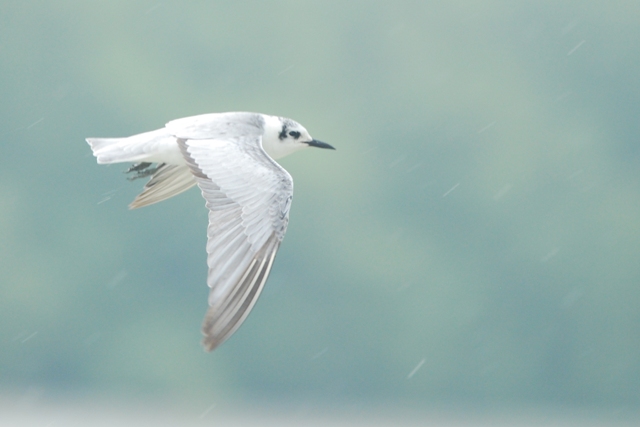
First, we encounter the commoner terns, like Little Terns, White-winged Terns and Great Crested Terns pretty near the coast and at the kelongs.

White-winged Tern

Great Crested Tern

As we went further out, we started seeing Bridled Terns heading south. We counted about 100 birds by the end of the boat trip.

Bridled Tern

The first star bird of the trip appeared around 9:45 am. It was an Aleutian Tern - a lifer for the Malaysian birders. The bird can be told apart from others by the white forehead, thin black bill, thin black trailing edge on the secondaries, white leading edge and pale rump.

Aleutian Tern

Before long, we encountered our first Swinhoe's Storm Petrel - another lifer for the Malaysian birders. We would see another two later. Finally, we spotted a pod of dolphins on the way back.

The final count of pelagic birds:
Swinhoe's Storm Petrel 3
Aleutian Tern 1
Common Tern 2
Bridled Tern ~100
Lesser Crested Tern 1
Great Crested Tern ~50
White-winged Tern ~10
Little Tern ~5

And water birds at Parit Jawa:
Lesser Adjutant 15
Grey Heron 5
Little Heron 3
Little Egret 5
Greater Sand Plover 1
Lesser Sand Plover >20
Common Greenshank 1
Common Redshank >20
Common Sandpiper 3
Terek Sandpiper >20
Whimbrel 1
Black-tailed Godwit 2
Red-necked Stint 5

From Con

http://confoley.com/parit-jawa-september-2012

Wednesday, June 6, 2012

Pulai, Palm Resort, Kukup, Pontian 3Dec11

From KH

Con, Danny and I went on a recce trip to Pulai and Kukup. After breakfast south of Gunung Pulai Recreational Forest (GPRF), we went round the western side to the northern entrance. Initially, we took a wrong turn and ended up at a camp, but just in time to catch a Changeable Hawk-eagle gliding past.

When we reached the entrance, there were already many cars. Apparently, residents have been visiting GPRF for some time, climbing the 700-m hill (4.7-km track) in slightly more than an hour.

Although the weather was cool, and the stream and waterfall were nice, the birds were not. The only notable birds were 2 unid needletails high up and a female Mugimaki Flycatcher. Other birds include a Striated Heron flushed from the stream, the calls of Short-tailed and Striped Tit-babblers, and friendly Orange-bellied Flowerpeckers and Dark-necked Tailorbirds. Mammal-wise, we saw a White-handed Gibbon, a male Pig-tailed Macaque, a bunch of Long-tailed Macaques and some squirrels.

Finally, at the 2nd steel bridge at the 2.76-km mark, we made our descent to continue our recce round GPRF.

Passing through our lifer town of Kulai, we soon reached Palm Resort at Senai. Failing to locate the Barred Eagle Owl, we went round the golf course, until back at the hotel block, the Indian workers pointed out the owl to us.


Left: Male. Right: Female sitting on nest in flower bed ©Con Foley

After lunch, we explored the eastern side of GPRF. We found the pond and reservoir, but no duck, only a Brown Shrike. Next up, Kukup.

Other than a bunch of Great Egrets flying to Pulau Kukup, there were not many birds there, although I did see a White-bellied Sea-eagle circling in the direction of Pulau Pisang. The most amazing thing here, to me, is how the mudskippers are able to thrive in the over-polluted mudflat. There was also a snake/eel in the water. Our aim here, however, is check out the rates of the boat - RM500 for 2-3 hours with 3-4 passengers.

Over at Pontian, the red earth area is pretty much the same as a few years ago. There was a Great Egret, a Grey Heron and a couple of Common Sandpipers. The rate here is RM800!

Sungei Balang, Parit Jawa, Malacca Strait, Muar 25-27Nov11

From JS

On 27th Nov, Con, my father (Danny) and I went for a short half-day (exactly 3h) pelagic along the Malacca Straits. The highlights being seeing a lot of feeding Aleutian Terns (probably the most common tern along the Malacca Straits at this point of time) and a lone passing Swinhoe's Storm Petrel - unfortunately, no photos for the latter. Additionally, we had a very close encounter with a large pod of >10 dolphins, including a jumpy baby.

Briefly, we started from the fishing village of Parit Jawa and headed out to the International Waters. Based on the few sighting records off Malacca Straits (Kedah) and Singapore Straits for the month of November, we were expecting a "dry" session and according to the local fishermen, there was a real chance of a "bird-less" outing. The first hour was literally (sea)bird-less, minus the few barn and pacific swallows. Fortunately, we had some dolphins as company for the first part of the second hour. After reaching close to the mid-point of the channel, we had our first sighting of a seabird, an Aleutian Tern. This followed by more sightings of Aleutian Terns before culminating with a rough count of 7 flying birds in a 100m radius of our boat (Poor visibility due to haze and impending storm), excluding 3 on driftwood (not rubbish!). On the way back, I spotted a lone Swinhoe's Storm Petrel heading in the direction of the Indian Ocean. Rounding up the trip, we saw a pair of Common Terns resting on a drift wood. Although the pelagic trip was done on an ad hoc basis, seeing some of our regional migrants appearing along the Malacca Straits may be newsworthy itself.

List of Seabirds seen along the Malacca Straits (MS) and Parit Jawa (PJ):
1) Little Tern (>10 at PJ and MS)
2) White-Winged Tern (>20 at PJ and MS)
3) Whiskered Tern (1 adult was seen at PJ)
4) Great Crested Tern (2 at MS)
5) Aleutian Tern (>10 at MS)
6) Swinhoe's Storm Petrel (1 all-dark petrel-like bird was seen and suggested to be of this species because of flight (close to the water surface with slight changes in direction, typical of passing Swinhoe's Storm Petrels along the Singapore Straits), darkish appearance, pigeon-headed and paler upperwing coverts.)
7) Common Tern (2 at MS)

Other notable sightings: Indopacific Bottlenose Dolphins (2 pods of >10 and >5 respectively. Both pods were seen heading towards Singapore Straits with one pod spending some time at the fishermen's net.)

Courtesy of Con, below link to his write up and wonderful pictures. http://confoley.com/trip-to-parit-jawa

List of Birds seen at S. Balang (SB), Parit Jawa (PJ), Malacca Straits (MS) and Muar (M) from 25-27/11/11:

1)White-Bellied Sea Eagle (1)
2) Brahminy Kite (>10)
3) Eastern Marsh Harrier (1 Juvenile was sighted at SB)
4) Pied Harrier (2, 1 sighting each at M and SB)
5) Accipiter Sp. (2, 1 sighting each at SB and PJ)
6) Black-Winged Kite (>4, sighting of 1 pair each at SB and M)
7) Wood Sandpiper (>100 at M and SB)
8) Common Sandpiper (>10 at M, SB and PJ)
9) Terek Sandpiper (>50 at PJ)
10) Common Greenshank (>3 at M and PJ)
11) Common Redshank (>50 at PJ)
12) Lesser Sand Plover (>100 at PJ)
13) Little Ringed Plover (>30 at SB and M)
14) Pacific Golden Plover (>30 at M, SB and PJ.)
15 Eurasian Curlew (4 at PJ)
16) Whimbrel (1 at PJ)
17) Little Egret
18) Cattle Egret
19) Great Egret
20) Intermediate Egret
21) Purple Heron
22) Grey Heron
23) Little Heron (>3 at SB and PJ)
24) Black-Crowned Night Heron (3 were seen returning to roost at PJ at dawn)
25) Pond Heron sp.
26) Lesser Adjutant (>20 at SB and PJ)
27) Greater Spotted Eagle (>2 were seen at SB, including 1 juvenile and 1 adult)
28) Chinese Goshawk (1 juvenile was seen at SB)
29) Little Tern (>10 at PJ and MS)
30) White-Winged Tern (>20 at PJ and MS)
31) Whiskered Tern (1 adult was seen at PJ)
32) Barn Swallow
33) Red-Rumped Swallow (1 bird was id at SB)
34) Pacific Swallow
35) Swiftlet sp.
36) Brown Shrike
37) Long-Tailed Shrike (2, 1 pair was seen at M)
38) Greater Racket-Tailed Drongo (1 bird was seen along the road)
39) Black Drongo (>8 at SB)
40) Black-Capped Kingfisher (1 at SB)
41) Collared Kingfisher
42) White-Throated Kingfisher
43) Stork-Billed Kingfisher (h)
44) Red-Necked Stint (>50 at PJ. As the birds were very far from us, even through the scope, we were not able to pick out any subtle difference in plumages to positively id any individual as little stint and we assumed all to be red-necked stints on the grounds of the higher likelihood of occurrence.)
45) Long-Toed Stint (>10 at SB)
46) Curlew Sandpiper (3 at PJ)
47) Yellow-Vented Bulbul
48) Black-Naped Oriole
49) Asian Koel
50) Little Bronze Cuckoo (h)
51) Rock Pigeon (>3 at SB and M)
52) Pink-Necked Pigeon
53) Spotted Dove
54) Zebra Dove
55) Oriental Reed Warbler (>5 at SB and M)
56) Rusty-Rumped Warbler (>3 at SB)
57) Zitting Cisticola (2 at SB)
58) Olive-Backed Sunbird (1 eclipse male at PJ)
59) Blue-Tailed Bee-Eater
60) Barn Owl (2 at SB, including 1 adult and 1 juvenile were seen inside a nest box that was one of the many installed at the Padi fields.)
61) Purple Swamphen (>5 at M)
62) Common Moorhen (>7 at M)
63) Watercock (2 at SB)
64) White-Breasted Waterhen
65) Ruddy Breasted Crake (1 at M)
66) White-Browed Crake (1 at M)
67) Cinnamon Bittern
68) Yellow Bittern
69) Lesser Whistling Duck (1 at M)
70) Common Snipe (>1, including 1 bird that was positively id in flight at SB)
71) Snipe sp.
72) Yellow Wagtail
73) Paddyfield Pipit
74) Eurasian Tree Sparrow
75) Oriental Pratincole (>50 at SB)
76) Dollarbird
77) Red-Wattled Lapwing
78) Barred Buttonquail (1at SB)
79) Magpie Robin
80) Golden Flameback (1 at M)
81) Brown Hawk Owl (h at PJ)
82) Common Myna
83) Javan Myna
84) Gerygone (h at PJ)
85) Scarlet-Backed Flowerpecker (h at PJ)
86) Red-Collared Dove (>20 at SB)
87) Scaly-Breasted Munia (>300 at SB)
88) White-Headed Munia (2 at SB)
89) Baya Weaver (>20 at M and SB)
90) House Crow
91) Large-Billed Crow
92) Glossy Starling
93) Great Crested Tern (2 at MS)
94) Aleutian Tern (>10 at MS)
95) Common Tern (2 at MS)
96) Swinhoe's Storm Petrel (1 all-dark petrel-like bird was seen and suggested to be of this species because of flight (close to the water surface with slight changes in direction, typical of passing Swinhoe's Storm Petrels along the Singapore Straits), darkish appearance, pigeon-headed and paler upperwing coverts.)

Aleutian Terns

Tuesday, May 29, 2012

Bt Tinggi 22Oct11

From Con

Oriental Honey-buzzard torquatus

Palm Resort 04Sep11

From Yamane

I’m happy to see you last Saturday in SBWR with some seashore birds. As you know, Con and I went to Palm Resort with Jean-Rene last Sunday. I attached 2 photos. One is some bird’s nest. Another is “2 photographers with their bazookas, chasing Owls, in the golf course”.


Of course, our target is Barred Eagle Owl. We seek them in the resort, but we could not find them. Con suggested to check the trees in the golf course. Also I agreed with him, in spite of worrying that our bazookas was hit by golf balls Con and Jean-Rene found a Owl. But he (or she) was cautious toward us. We could not take good photos. We could see the below birds there.

1. Collared Kingfisher
2. Olive-backed Sunbird

Monday, May 28, 2012

Palm Resort 08, 10Jul11

From Con

8 Jul

I went with Loong Tat today to the Le Grandeur Palm Resort which is right next to Senai Airport. Take 2nd Link. Here is the map location.

The owls are definitely there, there are two, an adult (probably the female) and the juvenile (several months old).

I just asked the concierge (name plate SAM) and he told me where the owls are. We got some pictures but they aren’t very good because the owls were obstructed in the trees, but you can easily see the features.

10 Jul

Loong Tat and I went up to Palm Resort again today; and again we weren’t very lucky. The owls were not in their roosts near the resort, these trees are lower and offer better photo ops. But we did find the owls up on the hill, the trees are high and not very photogenic.

Sunday, May 27, 2012

Hulu Langat, Bt Tinggi, Fraser's Hill 22-27Apr10

From Con

Dark Hawk-cuckoo taken on Telecom Loop this morning, perched open until a motorbike flushed it. This is the only view it gave none of the chest.


I spent a lot of time observing a pair of Rufous-browed Flycatchers building a nest near PKR bungalow. There was also a family of three Slaty-backed Forktails frequenting that section of Telecom Loop, I guess one must be the juvenile. Also got the Streaked Wren-babbler.

Here are mine of the Chestnut-backed Scimitar-babbler at Bt Tinggi. I found about 3 who were very responsive to tape, but also once they saw me took off in an instant! I just got an SMS from Jean Rene that someone saw Cutia near Green Acres very recently, sigh. This is the GPS coordinates for the ODKF nest at Hulu Langat near KL. Probably the ODKF fledges very soon, but Jean Rene's wife saw a Giant Pitta near this spot this week, about 200 meters up the hill on the right hand side. The Giant Pitta has been seen by several people over the last couple of months so it is not a one in a million chance, but somewhat better than that.

Sunday, May 20, 2012

Pontian, Tanjung Piai 27Sep08

From KH

Thanks to SC for showing us around his hometown. I got a few lifers from this trip! The 3 Lesser Adjutants early in the morning already made my day as I missed the Parit Jawa trip previously.


Besides the thick bill and mask, note the shallow forked tail ©Lau JS


Spot the Greater Sand-plover behind the Gull-billed Tern ©Lau JS

Then at the construction site, entered my lifer #2 - a single Gull-billed Tern. It was also lots of fun trying to single out possible Greater Sand-plovers from the hundreds of Lesser Sand-plovers. Of course not to forget the supporting cast of Common Sandpipers, PGPs, Common Redshanks, Terek Sandpipers, 2 Whimbrels and 1 Common Kingfisher. Also interesting were the Little Terns forming flocks of 10-20 to follow fishing boats out to the sea and returning once the boats reached deeper water - a behaviour you'll never see in Singapore!


Here are 2 photos of the Greater Sand-plovers. 1st was the one found by Danny, the 2nd was seen by Con and I while Con skillfully drove pass the plovers without flashing them ©Fang SC


Another GSP and zooming in on its head and bill ©Fang SC

Tanjung Piai offered cool breeze, more Whimbels and Terek Sandpipers, as well as my lifer #3 - a pair of Greater Flamebacks. A couple of very responsive Golden-bellied Gerygones keep us busy for a while. The OHB flushed at the entrance added to the tally of interesting sightings today. Last but not least, thanks SC for the breakfast!

Pontian (0700-1000)
1 Red Junglefowl (domestic)
2 Striated Heron
3 Grey Heron
4 Little Egret >2
5 Great Egret >5
6 Lesser Adjutant 3
7 Whimbrel 2
8 Common Redshank >50
9 Common Sandpiper >10
10 Terek Sandpiper >25
11 Pacific Golden-plover >5
12 Lesser Sand-plover >300
13 Greater Sand-plover >5
14 Little Tern >100
15 Gull-billed Tern 1
16 Brahminy Kite 1
17 Common Kingfisher 1
18 Collared Kingfisher
19 Blue-tailed Bee-eater 2
20 Spotted Dove
21 Swiftlet
22 House Crow
23 Large-billed Crow >10
24 White-vented Myna
25 Common Myna
26 Pacific Swallow
27 Barn Swallow
28 Ashy Tailorbird
29 Eurasian Tree Sparrow
30 Paddyfield Pipit 1

Tanjung Piai (1100-1400)
1 Lesser Adjutant 1
2 Whimbrel >15
3 Common Sandpiper >5
4 Terek Sandpiper >15
5 Little Tern >10
6 Brahminy Kite 1
7 Oriental Honey-buzzard 1
8 White-throated Kingfisher
9 Collared Kingfisher
10 Greater Flameback 1M1F
11 Swiftlet
12 White-breasted Waterhen
13 Golden-bellied Gerygone
14 Common Iora
15 Pacific Swallow
16 Red-rumped Swallow 1
17 Ashy Tailorbird
18 Arctic Warbler 3
19 Plain-throated Sunbird

From Con

Some photos from the weekend. According to Wells distribution map and text, the Greater Goldenback is confined to West Coast mangrove swamps in Peninsular Malaysia, but at about the Thai border moves further inland. So if Wells is correct, it would be pretty tough to see at Panti Forest, but some vagrants might turn up in Singapore.

The Black-tailed Godwit was still at SBWR around 11am today, Hide 1.11. Quite far away and sometimes it was sitting down among the other waders making it almost impossible to find, but once it is up and walking around, it is quite obvious. The Godwit stretched its wings showing the characteristic bold white band on black flight feathers confirming the ID as Black-tailed Godwit.

Gull-billed Tern in flight.

Just to show a comparison, the first link is Common Goldenbacks taken in Singapore. The second link is Common Goldenbacks taken in Palawan. As you can see they look a bit different, instead of a white stripes between the crown and black stripe the Palawan bird has more of a brown stripe.

Altogether, 3 lifers for me too this weekend.

Pontian 20Sep08

From SC

I think I found an alternate to Changi Cove at my hometown which is about 1.5 hour from Singapore at Pontian. I was there this morning when the tide coming in and saw quite a lot of waders at the seaside, when the tide start approaching the shore, these wader flew to a nearby construction site. Initially, I walked to the site and manage to photographed some plovers, later I decide to look for car entrance to the site and I found it!!

There are literally thousands of waders, but the most common are Lesser Sand-plovers and Common Redshanks. Also, I think there are at least 200 Little Terns.

1) Lesser Sand-plover female in breeding plumage


2) Terek Sandpiper


3) Curlew Sandpiper – Female in breeding plumage


4) Little Terns in flight

Saturday, May 19, 2012

Sungei Balang, Batu Gajah, Parit Jawa 01Dec07

From JS

Introduction

On 1st December 2007, Con, SC, Mike, Vincent, my father and I went to Sungei Balang and the nearby padi fields. Comparing S. Balang to Changi Cove, honestly, the diversity is less as S. Balang does not include any coastal mudflats and, most importantly, S. Balang is along Malacca Straits while Changi Cove is at the end where the Malacca Straits meets the South China Sea. Given this important location advantage, it is no wonder more birds would flock to Changi Cove as most migratory routes intersect there. Nevertheless, considering that Singapore’s freshwater marshes are deteriorating at a fast pace, S. Balang would be a good place to see the freshwater waders. Hopefully, the Teminick’s stint would show a VIP appearance.

Summaries of the birds seen at each location visited

Sungei Balang

Having a mix of large open woodlands and flooded padi fields, it is easy to see why it attracts so many raptors. Raptors sighted include two Greater Spotted Eagles, dozens of Black Kites and the resident raptors. Although the species list doesn’t sound so attractive, seeing dozens of them circling in BLUE sky is a spectacular but as it is a spectacular, I was too busy admiring it instead of photographing the spectacular scene.


Black Kite


Black-winged Kite

Batu Gajah

I don’t think I am the right guy to do a write-up on this place as I have only spent 1h there and saw only hundreds of waders and thousands of egrets. Noteworthy sightings would be a pair of ashy drongo of race nigrescens, a juvenile moorhen and dozens of long-toed stints.

Ashy Drongo nigrescens

Comments: My day trip range ends at Panti. Any place located further is for family outings. It is more educational to come here to see agriculture than to see birds. Most importantly, if you are lost while driving to this place, don’t ever ask anybody from the Petronas petrol kiosk. They are more likely to guide you back to Singapore than to your destination.

Parit Jawa

A short description of Parit Jawa: it is a small seaside town with endangered ugly birds. When I was there the tide was high, so I was only able to egrets, herons, adjutants and more egrets, more herons... From a birder’s point of view, 5 min is all one needs to see and id all the birds.

Lesser Adjutant


White-winged Terns

Comments: When you go there, order sweet potato leaves and all the different dishes of chicken wings, use the money saved from the seafood to spend on other things. If you are just passing Parit Jawa, on your way to Muar, have your lunch at Muar then.

List of birds seen in the trip

1) Greater Spotted Eagle (2)
2)  Black Kite
3)  Brahminy Kite
4)  Black-Winged Kite
5)  Osprey
6)  Lesser Adjutant
7)  Grey Heron
8)  Purple Heron
9)  Yellow Bittern
10) Cinnamon Bittern (1)
11) Little Heron
12) Great Egret
13) Cattle Egret
14) Little Egret
15) Common Moorhen (1)
16) Scaly-breasted Munia
17) Red-wattled Lapwing
18) Common Greenshank
19) Common Redshank
20) Marsh Sandpiper
21) Common Sandpiper
22) Wood Sandpiper
23) Long-toed Stint
24) Asian Pied Starling
25) Asian Glossy Starling
26) House Crow
27) Large-billed Crow
28) Common Myna
29) Javan Myna
30) Black Drongo
31) Ashy Drongo (2)
32) Blue-tailed Bee-eater
33) Yellow-vented Bulbul
34) Spotted Dove
35) Zebra Dove
36) Eurasian Tree Sparrow
37) White-winged Tern

More photos from Jia Sheng:


Left: Ashy Drongo nigrescens. Right: Lesser Adjutant


Asian Pied Starlings


White-winged Terns